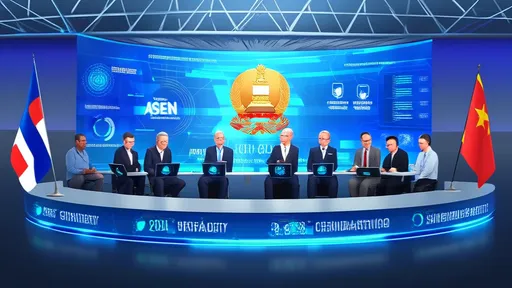
The bustling conference hall in Singapore fell silent as Dr. Amina Sharma adjusted her microphone, her voice carrying the weight of decades in technology diplomacy. "We stand at a crossroads not just of technological advancement, but of geopolitical alignment," she began, addressing the assembled delegates from ASEAN nations and the United States. "The frameworks we build today for artificial intelligence will determine the digital sovereignty of generations to come." Her words echoed a sentiment that has been quietly gaining momentum in diplomatic circles from Jakarta to Washington D.C.—that the future of AI governance is being written now, and the ASEAN-U.S. partnership represents a crucial chapter.
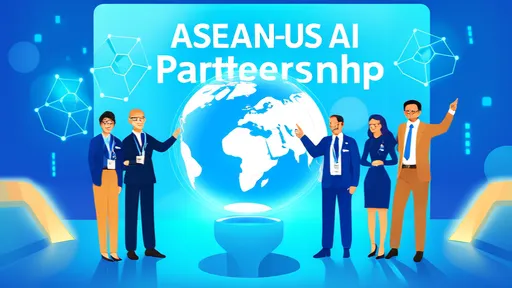
The collaboration between the Association of Southeast Asian Nations and the United States represents one of the most significant yet understated developments in global technology policy. Unlike the more publicized AI arms race between superpowers, this partnership operates through working groups, joint research initiatives, and policy harmonization efforts that rarely make headlines. Yet its implications stretch far beyond the meeting rooms where technical standards are debated. What's emerging is a deliberate effort to create what officials term "an open yet secure digital ecosystem"—a framework that promotes innovation while addressing the unique challenges facing Southeast Asia's diverse economies.
Economic Imperatives Drive Cooperation
Beneath the diplomatic language lies a stark economic reality. ASEAN's collective economy, projected to become the world's fourth largest by 2030, cannot afford to be sidelined in the AI revolution. The region's digital economy is expected to reach $1 trillion by 2030, with AI-driven technologies accounting for increasingly significant portions of this growth. American technology companies, meanwhile, recognize that Southeast Asia's young, digitally-savvy population of over 650 million represents both a massive market and a crucial testing ground for AI applications tailored to diverse cultural contexts.
Recent months have seen concrete steps beyond mere memoranda of understanding. The U.S. Department of Commerce has established joint working groups focusing on AI standards development with counterparts in Singapore, Malaysia, and Vietnam. These groups operate with remarkable pragmatism, addressing everything from cross-border data flow protocols to certification frameworks for AI systems used in financial services. "We're not reinventing the wheel," noted a senior U.S. trade official who requested anonymity. "We're adapting existing best practices to Southeast Asia's specific needs while ensuring American technologies remain competitive against alternative systems being promoted elsewhere."
Security Concerns Shape Technical Standards
The term "secure ecosystem" appears repeatedly in joint statements, but what does it mean in practice? Interviews with participants in the working groups reveal a multifaceted approach. Cybersecurity forms the bedrock, with joint initiatives focusing on protecting critical infrastructure—particularly financial systems and telecommunications networks—from AI-powered threats. Singapore's Cyber Security Agency has been working closely with U.S. counterparts to develop red-teaming exercises specifically designed to test AI systems against sophisticated attacks.
Perhaps more significantly, security extends to what officials term "strategic resilience." This involves reducing dependency on any single technology provider or nation. The partnership actively promotes the development of homegrown AI capabilities within ASEAN nations while ensuring interoperability with American systems. Malaysia's recent announcement of a sovereign AI development fund, supported by technical assistance from U.S. National Laboratories, exemplifies this approach. As Datuk Seri Azman Ibrahim, Malaysia's Minister of Science and Technology, explained during a recent briefing: "We're building capabilities, not just buying products. The knowledge transfer component is written into every agreement."
The Openness Paradox
Balancing openness with security presents what one Thai negotiator called "the central tension" in the partnership. Openness, in this context, means ensuring American AI companies can operate in ASEAN markets with minimal restrictions, while ASEAN nations gain access to cutting-edge technologies and investment. The security dimension, however, requires careful scrutiny of these same technologies and the data they process.
This tension manifests most clearly in discussions about data governance. Negotiators are crafting what they term "managed openness"—a system that allows data to flow across borders for business and research purposes while maintaining safeguards for sensitive information. The recently concluded ASEAN-U.S. Data Classification Framework represents a breakthrough in this area, creating tiered categories of data with corresponding protection requirements. "We've moved beyond the binary debate of data localization versus completely free flow," explained Dr. Sophia Williams, who led the U.S. negotiating team. "The framework acknowledges that different types of data require different levels of protection."
Implementation Challenges Across Diverse Economies
The partnership's success ultimately depends on implementation across ASEAN's enormously varied economic landscape. While Singapore may have the technical infrastructure and regulatory sophistication to immediately adopt advanced AI governance frameworks, less developed members require phased approaches. The U.S. Agency for International Development has committed $50 million to building AI capacity in Cambodia, Laos, and Myanmar, focusing on basic digital infrastructure and workforce development.
Private sector involvement has been crucial in bridging these gaps. Microsoft's announcement of a $2 billion investment in ASEAN AI infrastructure over the next five years includes specific commitments to developing cloud computing capabilities in secondary cities across Indonesia, Thailand, and the Philippines. Google's AI research center in Bangkok not only serves Thailand but functions as a regional hub training data scientists from across ASEAN. As Google's Southeast Asia policy lead noted: "We're not just extracting data; we're building capabilities that remain in the region."
Geopolitical Undercurrents
While official statements emphasize technical cooperation, the partnership unfolds against a backdrop of strategic competition. Chinese technology companies have made significant inroads across Southeast Asia, particularly in telecommunications infrastructure and consumer applications. The ASEAN-U.S. AI partnership offers an alternative model—one that American officials carefully position as "values-based" rather than explicitly anti-China.
This positioning requires delicate diplomacy. ASEAN nations maintain important economic relationships with China and generally avoid frameworks perceived as containment strategies. The success of the AI partnership thus depends on demonstrating tangible economic benefits rather than engaging in ideological rhetoric. Vietnam's decision to partner with U.S. firm NVIDIA on AI development for its manufacturing sector, while maintaining Huawei's involvement in other technology areas, illustrates this pragmatic balancing act.
The Human Capital Dimension
Technology transfer means little without knowledge transfer. The partnership's most innovative aspect may be its focus on developing human capital. The U.S.-ASEAN University Connect initiative has expanded to include twenty-seven American universities partnering with forty-three ASEAN institutions on AI curriculum development. The program goes beyond traditional academic exchanges to include industry immersion, with students spending six months interning at U.S. tech companies working on ASEAN-focused projects.
This focus on education addresses what could otherwise become a significant point of tension—the brain drain of top AI talent to Silicon Valley. By creating attractive career pathways within Southeast Asia, the partnership aims to develop regional AI ecosystems that retain talent. Indonesia's new AI research institute, funded jointly by the Indonesian government and U.S. tech companies, offers compensation packages competitive with regional offices of multinational corporations, representing a significant shift in strategy.
Looking Ahead: From Framework to Implementation
The coming eighteen months will be crucial for translating agreements into action. Three joint working groups are scheduled to deliver concrete proposals: one on cross-border testing of AI systems, another on mutual recognition of AI certifications, and a third on coordinated response mechanisms for AI-related security incidents. The success of these efforts will determine whether the partnership becomes a model for international AI cooperation or another well-intentioned but ultimately limited diplomatic exercise.
As Dr. Sharma noted in her concluding remarks in Singapore: "We're building the plane while flying it. The technology won't wait for our committees to reach perfect consensus." This acknowledgment of the breakneck pace of AI development underscores both the urgency and the ambition of the ASEAN-U.S. partnership. In an era of technological fragmentation, their attempt to build bridges rather than walls represents a significant experiment in global governance—one whose outcome will influence not just Southeast Asia and the United States, but the future shape of the global digital economy.

By /Oct 21, 2025
By /Oct 21, 2025

By /Oct 21, 2025

By /Oct 21, 2025

By /Oct 21, 2025

By /Oct 21, 2025
By /Oct 21, 2025

By /Oct 21, 2025

By /Oct 21, 2025

By /Oct 21, 2025

By /Oct 21, 2025
By /Oct 21, 2025

By /Oct 21, 2025

By /Oct 21, 2025

By /Oct 21, 2025

By /Oct 21, 2025

By /Oct 21, 2025

By /Oct 21, 2025

By /Oct 21, 2025

By /Oct 21, 2025