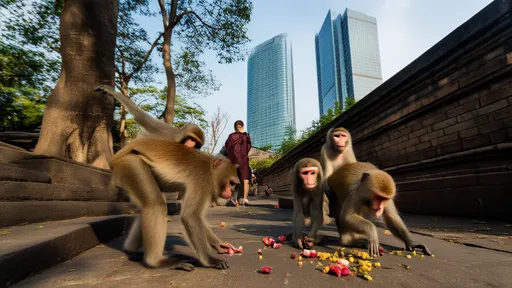
In the bustling cities of India, a unique ecological dilemma unfolds daily on rooftops, temples, and crowded marketplaces. The revered Hanuman langur, celebrated in Hindu mythology as the divine monkey god Hanuman's progeny, has become an unexpected urban dweller. These agile creatures, once confined to forest canopies, now navigate concrete jungles with startling adaptability, creating complex intersections between human civilization and wildlife.
The phenomenon isn't merely about monkeys invading cities—it's a profound ecological displacement with cultural undertones. Delhi's government buildings witness parliamentary documents torn apart by nimble fingers, while Mumbai's high-rises face raids on fruit vendors' carts. What appears as nuisance behavior stems from shrinking habitats; approximately 40% of India's primate species now interface regularly with urban areas according to recent wildlife surveys.
Religious reverence complicates conservation efforts. At Jaipur's Galta Monkey Temple, pilgrims feed langurs bananas as religious offerings, conditioning the primates to associate humans with food. This sacred bond has turned problematic—monkey bites account for 20% of animal injury cases in urban hospitals. Yet attempts to relocate troops meet fierce resistance from devotees who view the animals as manifestations of Hanuman.
Ecologists observe disturbing behavioral shifts. Urban langurs develop darker coats from pollution exposure and exhibit 30% smaller home ranges than forest-dwelling counterparts. Their diets now include processed foods scavenged from garbage, leading to diabetes cases identified during capture-sterilization programs. The famous langurs of Varanasi even demonstrate traffic-crossing strategies, waiting for red lights before descending on vehicles.
Traditional solutions backfire spectacularly. Municipalities once employed larger male langurs as "monkey controllers" to scare away smaller rhesus macaques—only to create super-troops of aggressive hybrids. The infamous 2007 incident where deputy mayor S.S. Bajwa fell to his death during a monkey attack prompted the Delhi High Court to declare urban primates "invaders," yet enforcement remains tangled in legal and cultural debates.
Innovative approaches emerge amidst the chaos. Biomedical researchers collaborate with temple priests to collect health data during religious feedings. Urban planners design "green corridors" connecting fragmented habitats, while AI-powered tracking systems monitor troop movements. The Jaipur Monkey Foundation even trains rescued langurs as "monkey mediators" to peacefully interact with human neighbors.
This ecological paradox reflects India's broader struggle to balance modernity with tradition. As concrete spreads, the sacred monkeys force society to confront uncomfortable questions: Can urban ecosystems accommodate wildlife without conflict? Does religious protection hinder ecological responsibility? The chattering troops swinging through metro wires serve as living reminders that nature adapts—but not always in ways humans anticipate.
The monsoon season brings temporary truces, as langurs retreat to remaining forest patches to breed. But when the rains cease, the urban invasion resumes—a cyclical dance of coexistence and conflict that may ultimately redefine what it means to be wild in 21st-century India. Wildlife experts warn that without systemic solutions, cities risk creating entire generations of semi-domesticated primates biologically and behaviorally divorced from their natural heritage.
By /Aug 12, 2025

By /Aug 12, 2025

By /Aug 12, 2025

By /Aug 12, 2025

By /Aug 12, 2025

By /Aug 12, 2025
By /Aug 12, 2025

By /Aug 12, 2025

By /Aug 12, 2025
By /Aug 12, 2025
By /Aug 12, 2025

By /Aug 12, 2025

By /Aug 12, 2025

By /Aug 12, 2025

By /Aug 12, 2025

By /Aug 12, 2025

By /Aug 12, 2025

By /Aug 12, 2025
By /Aug 12, 2025

By /Aug 12, 2025