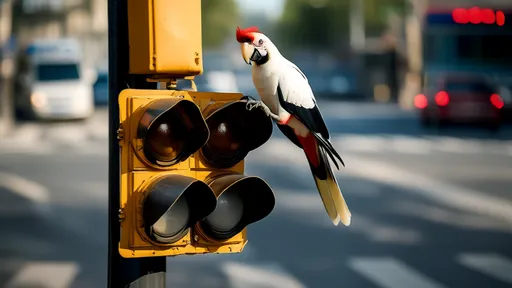
In the bustling urban landscapes of Sydney, an unexpected intelligence has been observed among the local sulphur-crested cockatoos. These striking white birds, known for their raucous calls and playful antics, have demonstrated a remarkable ability to manipulate traffic signals to their advantage. This behavior, which involves carefully prying open traffic light casings to access food, has left scientists and city officials both fascinated and perplexed.
The behavior was first documented by researchers in 2019, though locals had reported similar incidents for years prior. The cockatoos use their powerful beaks to lift the heavy rubber seals around traffic light buttons, triggering the signal change. Once the light turns red, they feast on the insects and spiders that gather around the warm electronics inside. This ingenious method of foraging highlights the adaptability of these birds in urban environments.
What makes this phenomenon particularly intriguing is the apparent social learning component. Not all cockatoos in Sydney engage in this behavior – it seems to be concentrated in specific suburbs where the technique has been passed down through generations. Younger birds carefully observe and mimic the actions of older, more experienced individuals, creating a cultural transmission of knowledge unique to certain flocks.
Transport authorities initially viewed this behavior as vandalism, but have since recognized it as a fascinating example of animal intelligence adapting to human infrastructure. The birds don't damage the equipment permanently – their manipulation is precise enough to avoid breaking components while still achieving their goal. This delicate balance between animal ingenuity and urban functionality presents an unusual challenge for city planners.
The cockatoos' traffic light hacking has sparked debates about urban wildlife management. Some residents admire the birds' cleverness, while others worry about potential traffic disruptions. Interestingly, the birds seem to time their interventions carefully, typically during quieter periods when their manipulation won't cause major congestion. This suggests an understanding of traffic patterns that goes beyond simple cause-and-effect learning.
Biologists studying this behavior note that it represents a rapid evolutionary adaptation to city life. The sulphur-crested cockatoo population in Sydney has grown significantly in recent decades, partly due to their ability to exploit human environments. Their traffic light manipulation is just one example of how they've turned urban infrastructure to their advantage, joining the ranks of other animals like crows and raccoons that show similar urban problem-solving skills.
As researchers continue to monitor this behavior, they're discovering more about the cognitive abilities of these birds. The precision required to manipulate traffic lights without damaging them indicates advanced motor skills and spatial awareness. Moreover, the social transmission of this technique suggests complex communication and teaching behaviors that were previously underestimated in parrot species.
The phenomenon has also raised questions about how cities might need to adapt to increasingly intelligent urban wildlife. Some intersections in Sydney have begun installing cockatoo-proof traffic light covers, creating an evolutionary arms race between birds and engineers. These adaptations, while solving the immediate issue, may simply push the cockatoos to develop new strategies, continuing the cycle of innovation on both sides.
Beyond the scientific implications, the traffic-light hacking cockatoos have become local celebrities. Their antics are frequently captured on video by amused residents and shared widely on social media. This public fascination has helped foster greater appreciation for urban wildlife and sparked conversations about how humans can better coexist with intelligent animal neighbors.
Looking forward, researchers plan to continue studying how this behavior spreads through cockatoo populations and whether it might emerge in other cities. The Sydney case provides a unique opportunity to observe cultural transmission in animals in real-time, offering insights that could reshape our understanding of animal intelligence and adaptability in human-dominated environments.
By /Aug 12, 2025

By /Aug 12, 2025
By /Aug 12, 2025
By /Aug 12, 2025
By /Aug 12, 2025

By /Aug 12, 2025
By /Aug 12, 2025
By /Aug 12, 2025
By /Aug 12, 2025
By /Aug 12, 2025
By /Aug 12, 2025
By /Aug 12, 2025
By /Aug 12, 2025
By /Aug 12, 2025
By /Aug 12, 2025
By /Aug 12, 2025

By /Aug 12, 2025
By /Aug 12, 2025
By /Aug 12, 2025
By /Aug 12, 2025