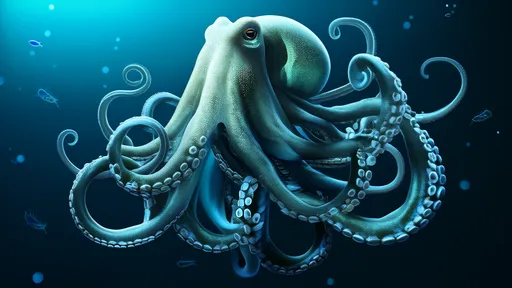
The ocean's depths hold countless mysteries, but few are as fascinating as the cephalopod's approach to dining. Unlike any land-dwelling creature, octopuses possess a radical decentralized nervous system that extends beyond their brains—quite literally into their arms. This biological marvel allows each of their eight limbs to "taste" and react to their environment independently while foraging. Recent studies reveal this distributed sensory network operates with startling sophistication, blurring the line between touch and chemical perception in ways that could revolutionize soft robotics and adaptive AI systems.
A Tongue in Every Sucker
Beneath the dexterous surface of an octopus arm lies a revelation: each sucker contains chemosensory cells akin to taste buds, but with processing power that defies vertebrate biology. When exploring crevices for crabs or clams, these suckers don't merely transmit data to a central brain—they make snap decisions. Researchers at the Marine Biological Laboratory discovered that severed octopus arms continue executing complex motions like grasping and rejecting objects based on chemical cues. This suggests each sucker cluster functions as a microscopic "brainlet," evaluating prey suitability through what scientists now call distributed gustatory computation.
The implications are profound. An octopus doesn't experience flavor as humans do—a unified sensation perceived after chewing. Instead, its arms engage in what marine neurobiologists describe as pre-ingestive flavor profiling. As Dr. Tara Abrina of the University of Chicago explains, "Their arms discriminate between edible and toxic substances at first contact, sometimes retracting before the central brain registers the threat. It's like having eight opinionated food critics working simultaneously." This system proves invaluable when hunting in pitch-black environments where visual confirmation is impossible.
Neurobiology Rewritten
Traditional neuroscience struggles to categorize this decentralized intelligence. Octopuses possess 500 million neurons—comparable to dogs—but two-thirds reside in their arms. These neurons form local circuits capable of learning; in experiments, blinded octopuses taught their arms to recognize textured containers holding food through touch alone. The limbs retained this knowledge even when reassigned to different tasks, demonstrating what Professor Hiroto Yokawa calls appendage-specific memory.
This challenges our understanding of cognition's boundaries. An octopus arm detached due to predation continues responding to stimuli for over an hour—not through reflexes, but sustained by self-contained neural ganglia. Some biologists argue this qualifies as a novel form of embodied intelligence, where sensory processing occurs at the interaction site rather than being routed through a command center. The evolutionary advantage is clear: reduced latency in life-or-death decisions when milliseconds matter.
Soft Robotics' New Paradigm
Engineers at MIT's Soft Active Materials Lab have taken notes from octopus biology, developing grippers lined with hydrogel-based "taste sensors." These prototype tentacles don't just grasp objects; they adjust grip strength based on chemical traces detected through embedded biosensors. Project lead Dr. Elena Vostrikova notes, "Our materials change stiffness when encountering specific molecules—just like an octopus arm stiffens upon contacting prey." Early applications include underwater salvage robots that can distinguish between metallic alloys and pollutant cleanup drones that selectively absorb oil.
The pharmaceutical industry sees potential too. Octopus-inspired surgical tools could "taste" abnormal tissues during minimally invasive procedures. A collaboration between Tokyo Tech and Johns Hopkins has produced a tentacle-like endoscope that identifies cancerous cells by their surface chemistry, reducing biopsy errors. As Dr. Vostrikova observes, "We're moving from programmed machines to devices that make contextual decisions at every contact point—just as evolution designed cephalopods to do."
The Consciousness Conundrum
Perhaps the most unsettling question arises: if an octopus arm can learn and decide independently, does it possess fragmentary consciousness? Philosophers of mind and marine biologists recently convened at the Cephalopod Cognition Symposium to debate this. While no consensus emerged, experiments demonstrate that arms occasionally contradict the central brain's intentions—like continuing to hunt when the octopus attempts to retreat from danger. This has led some researchers to propose a multi-agency model of octopus cognition, where consciousness (if present) might be distributed differently than in vertebrates.
What seems certain is that evolution arrived at an extraordinary solution for survival in complex environments. As we decode these mechanisms, we're not just learning about octopuses—we're glimpsing alternative frameworks for intelligence itself. The octopus challenges our anthropocentric assumptions, proving that sophisticated problem-solving doesn't require a dominant brain, just an elegantly decentralized network of tasting, touching, and decision-making limbs.
By /Aug 12, 2025

By /Aug 12, 2025

By /Aug 12, 2025
By /Aug 12, 2025

By /Aug 12, 2025

By /Aug 12, 2025

By /Aug 12, 2025

By /Aug 12, 2025
By /Aug 12, 2025
By /Aug 12, 2025

By /Aug 12, 2025
By /Aug 12, 2025
By /Aug 12, 2025

By /Aug 12, 2025

By /Aug 12, 2025

By /Aug 12, 2025

By /Aug 12, 2025
By /Aug 12, 2025
By /Aug 12, 2025
By /Aug 12, 2025