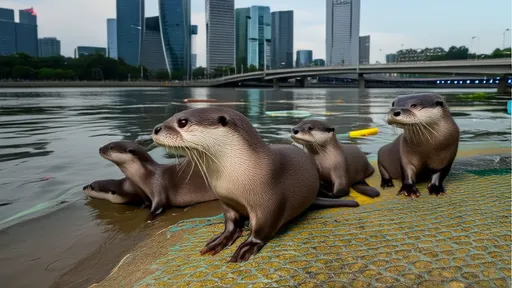
The bustling city-state of Singapore is known for its gleaming skyscrapers, efficient public transport, and lush green spaces. But beneath its urban veneer lies a thriving ecosystem where an unexpected creature has carved out a niche—the smooth-coated otter. These charismatic mammals have not only adapted to city life but have also established complex social structures, complete with family territories demarcated by the city’s extensive canal network. The Singapore Otter Working Group, a coalition of researchers and wildlife enthusiasts, has been meticulously documenting these behaviors, revealing a fascinating interplay between urban infrastructure and wildlife.
The smooth-coated otter (Lutrogale perspicillata) is a species native to Southeast Asia, and in Singapore, they have become a symbol of the country’s successful conservation efforts. Once nearly extinct on the island due to pollution and habitat loss, otters have made a remarkable comeback over the past two decades. Today, they are a common sight along Singapore’s waterways, where they hunt, play, and raise their young. What makes their resurgence even more intriguing is how they’ve organized themselves into distinct family groups, each claiming stretches of the city’s canals as their own.
These otter families, often referred to as "romps," are highly territorial. The Singapore Otter Working Group has identified several prominent families, including the Bishan otters and the Marina otters, each with their own well-defined boundaries. The canals, originally built for drainage and flood control, have inadvertently become the perfect corridors for otters to patrol and defend. Observations suggest that these territories are not static; they shift in response to changes in food availability, human activity, and even conflicts between otter groups.
One of the most studied aspects of otter behavior in Singapore is their use of vocalizations and scent markings to assert dominance over their chosen stretches of water. Researchers have noted that when two otter families encounter each other near a territorial boundary, the interactions can range from cautious avoidance to aggressive confrontations. These clashes, though rarely violent, are intense affairs, with otters arching their backs, hissing, and sometimes engaging in brief chases. The defeated group typically retreats, allowing the victors to reinforce their claim over the contested area.
Human activity plays a significant role in shaping these otter territories. Construction projects, changes in water quality, and even the presence of recreational boaters can force otter families to adjust their ranges. For instance, when a popular stretch of canal undergoes maintenance, the otters may temporarily relocate to quieter tributaries until the disturbance subsides. This adaptability highlights their resilience but also raises questions about the long-term sustainability of their urban habitats.
The Singapore Otter Working Group has been instrumental in raising public awareness about these creatures. Through social media, guided otter-watching tours, and collaborations with local authorities, the group has fostered a sense of shared responsibility for the otters’ well-being. Residents are encouraged to observe otters from a distance, avoid feeding them, and report any injured or distressed animals. This community-driven approach has helped mitigate conflicts between humans and otters, ensuring that both can coexist harmoniously.
Despite their success, challenges remain. As Singapore continues to develop, the pressure on otter habitats will only increase. Urban planners and conservationists face the delicate task of balancing infrastructure needs with wildlife preservation. The otters’ reliance on canals, for example, means that any major alterations to these waterways could have unintended consequences. There’s also the looming threat of climate change, which could alter rainfall patterns and disrupt the delicate balance of Singapore’s aquatic ecosystems.
Yet, the story of Singapore’s otters is ultimately one of hope. It demonstrates how even in one of the world’s most densely populated cities, nature can find a way to thrive. The otters’ intricate social structures and their ability to adapt to an ever-changing environment serve as a reminder of the resilience of wildlife. As the Singapore Otter Working Group continues its research, each new discovery adds another layer to our understanding of these remarkable animals and their place in the urban jungle.
For now, the otters remain a beloved fixture of Singapore’s natural landscape, their playful antics bringing joy to residents and visitors alike. Whether they’re sliding down muddy banks, grooming each other on sunlit rocks, or gliding effortlessly through the water, they are a testament to the enduring connection between humans and the natural world. And as long as their territories are respected and their habitats protected, these sleek, whiskered ambassadors of urban wildlife will continue to flourish.
By /Aug 12, 2025

By /Aug 12, 2025
By /Aug 12, 2025

By /Aug 12, 2025
By /Aug 12, 2025

By /Aug 12, 2025
By /Aug 12, 2025
By /Aug 12, 2025

By /Aug 12, 2025

By /Aug 12, 2025
By /Aug 12, 2025

By /Aug 12, 2025

By /Aug 12, 2025
By /Aug 12, 2025
By /Aug 12, 2025
By /Aug 12, 2025

By /Aug 12, 2025
By /Aug 12, 2025

By /Aug 12, 2025

By /Aug 12, 2025