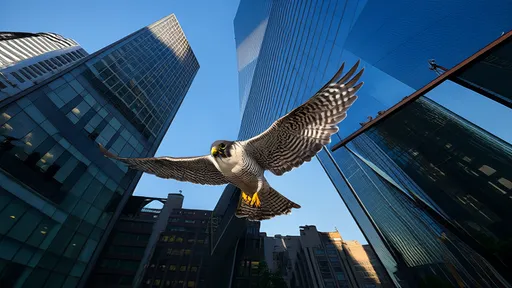
New York City’s skyline, a glittering maze of steel and glass, has long been a symbol of human ingenuity. But for one unlikely resident—the peregrine falcon—these towering structures have become an unexpected ally in the art of hunting. Recent observations by urban wildlife researchers reveal how these apex predators have adapted to the challenges of city life, turning the reflective surfaces of glass-clad skyscrapers into tools for ambushing prey.
Peregrine falcons, once pushed to the brink of extinction by pesticide use in the mid-20th century, have made a remarkable comeback in urban environments. Cities like New York, with their abundant pigeon populations and lack of natural predators, offer ideal hunting grounds. But it’s the falcons’ innovative use of glass reflections that has stunned scientists. Unlike in open landscapes where falcons rely on sheer speed—reaching over 240 mph in a dive—urban hunting demands a different strategy. Here, the birds exploit the mirrored facades of buildings to disorient and trap their prey.
The Mechanics of Reflection Hunting
Researchers documented multiple instances where peregrines used glass reflections to create false openings or pathways. Pigeons, their primary prey, often mistake these reflections for clear flight paths, only to collide with the hard surface or veer into the falcon’s clutches. Dr. Elena Carter, a behavioral ecologist at Cornell University, describes this as a form of "visual deception." "The falcons aren’t just adapting to the city—they’re weaponizing its architecture," she notes. High-speed cameras captured falcons herding pigeons toward reflective angles, effectively using the buildings as hunting blinds.
This behavior isn’t limited to daylight hours. At dusk, when artificial lights amplify glass reflections, falcons have been observed initiating hunts near illuminated high-rises. The interplay of light and shadow confuses prey, making escapes nearly impossible. One particularly striking case involved a falcon near the Chrysler Building, which repeatedly drove pigeons toward a glass corner until they were trapped in a reflective "dead end."
Evolution in Real Time
What fascinates scientists most is the speed of this adaptation. Glass-dominated skylines are a recent phenomenon in evolutionary terms, yet peregrines have already incorporated them into their hunting repertoire. Comparative studies show urban falcons develop this skill through trial and error, suggesting it’s learned behavior rather than instinct. Juvenile falcons in rural areas exhibit no such tactics, while their city-raised counterparts begin testing reflections as early as six months old.
The implications extend beyond ornithology. Architects and urban planners are now reconsidering building designs to mitigate unintended consequences for wildlife. Some propose "bird-friendly" glass treatments, like fritted patterns, which break up reflections visible to birds but appear seamless to humans. Yet the falcons’ adaptability raises questions: Will future generations of urban wildlife evolve to exploit even these modified surfaces?
A Delicate Balance
While the falcons’ success story highlights nature’s resilience, it also underscores the complex relationship between urbanization and wildlife. The very adaptations that help peregrines thrive—capitalizing on human-made structures—may simultaneously endanger other species. Collisions with glass kill an estimated 600 million birds annually in the U.S. alone, making buildings deadlier than predators or pesticides. The falcons’ niche strategy offers a grim irony: they benefit from a hazard that devastates other birds.
Conservationists argue for a dual approach—celebrating the falcon’s comeback while addressing the broader ecological impact of urban design. "We’re witnessing an extraordinary evolutionary arms race," says Carter. "The falcons are winning, but at what cost to the ecosystem?" As cities continue to grow vertically, the dance between predator, prey, and architecture will only intensify, offering a living laboratory for studying adaptation in the Anthropocene.
For now, New Yorkers might glance up to see a feathered blur against a glass tower—a reminder that even in the most engineered environments, nature finds a way to write its own rules.
By /Aug 12, 2025

By /Aug 12, 2025
By /Aug 12, 2025
By /Aug 12, 2025
By /Aug 12, 2025

By /Aug 12, 2025

By /Aug 12, 2025
By /Aug 12, 2025
By /Aug 12, 2025
By /Aug 12, 2025
By /Aug 12, 2025

By /Aug 12, 2025
By /Aug 12, 2025
By /Aug 12, 2025
By /Aug 12, 2025
By /Aug 12, 2025

By /Aug 12, 2025
By /Aug 12, 2025
By /Aug 12, 2025
By /Aug 12, 2025