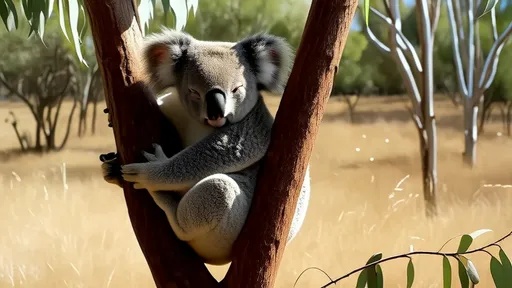
The koala, an iconic marsupial native to Australia, has long fascinated scientists with its unique adaptations to a highly specialized diet of eucalyptus leaves. Among its most intriguing evolutionary trade-offs is the phenomenon of brain shrinkage—a remarkable example of energy conservation in nature. This physiological compromise raises profound questions about the relationship between cognitive capacity and survival strategies in extreme ecological niches.
Unlike most mammals that prioritize brain development, koalas exhibit a strikingly small brain relative to their body size. Recent neuroanatomical studies reveal their brains fill merely 60% of the cranial cavity, with some specimens showing as little as 40% occupancy. This cerebral reduction isn't congenital but develops progressively as juveniles transition to their toxic eucalyptus diet. The shrinkage predominantly affects the cerebral cortex—the region associated with complex cognition in mammals—while preserving areas essential for basic life functions.
The driving force behind this extraordinary adaptation lies in the koala's perilous dietary choice. Eucalyptus leaves are not only nutritionally deficient—providing less than half the caloric density of typical herbivore diets—but also contain toxic phenolic compounds that require extensive detoxification. Processing this hazardous foliage demands an extraordinary 20 hours of daily digestion, leaving minimal energy reserves for other physiological processes. In this context, maintaining a large, energy-hungry brain becomes an unsustainable luxury.
Metabolic studies demonstrate that the koala's brain consumes only 10% of its resting energy budget, compared to 20% in similar-sized mammals. This halving of neural energy expenditure provides a crucial survival advantage when daily caloric intake barely meets basic requirements. The evolutionary trade-off appears stark: reduced cognitive capacity in exchange for guaranteed access to an abundant food source avoided by competitors. Nature has essentially traded problem-solving skills for digestive specialization—a strategy that has sustained koalas through millennia of environmental changes.
Behavioral observations corroborate the anatomical findings. Koalas exhibit limited behavioral flexibility compared to other arboreal marsupials. Their problem-solving abilities are rudimentary, spatial memory appears constrained, and they show minimal curiosity toward novel stimuli. While these cognitive limitations would prove disastrous for generalist species, they represent an acceptable compromise for an organism that spends most of its life motionless in tree canopies, methodically processing toxic foliage.
The koala's neural reduction carries intriguing parallels with other extreme dietary specialists. Like the giant panda's gut anatomy or the sloth's metabolic depression, it exemplifies how evolutionary pressures can reshape fundamental mammalian traits when ecological circumstances demand radical adaptation. This phenomenon challenges anthropocentric assumptions about brain size as an absolute measure of evolutionary success, instead highlighting context-dependent fitness strategies.
Conservation implications of this adaptation are profound. The koala's specialized neurology makes it particularly vulnerable to rapid environmental changes. Unlike cognitively flexible species that can adapt behaviorally to habitat alteration, koalas face existential threats from climate-induced changes in eucalyptus leaf composition and the increasing frequency of bushfires disrupting their limited movement corridors. Their evolutionary triumph has become an ecological Achilles' heel in the Anthropocene epoch.
Recent genomic studies reveal an unexpected twist: the koala genome contains an unusually high number of genes related to neural development and function. This genetic "toolkit" suggests their ancestors possessed more complex brains before specializing on eucalyptus. The current small brain likely represents an active downregulation of neural capacity rather than genetic degeneration—a subtle but important distinction demonstrating evolution's ability to fine-trade physiological traits without losing underlying genetic potential.
As climate change alters the nutritional profile of eucalyptus forests, scientists are monitoring whether koalas might face selective pressures favoring slightly larger brains capable of more flexible foraging strategies. However, the species' extremely slow reproductive rate and specialized gut microbiome make rapid evolutionary adjustments unlikely. The koala's predicament illustrates the double-edged nature of extreme specialization—while providing short-term survival advantages, it often limits long-term evolutionary flexibility.
The koala's brain reduction stands as one of nature's most striking examples of metabolic prioritization. In an era where human activities are dramatically reshaping planetary ecosystems, this marsupial's evolutionary story offers sobering insights about the trade-offs between specialization and adaptability. Its survival through millennia demonstrates that sometimes, in nature's calculus, being "smart" isn't about cognitive complexity but rather about perfecting energy efficiency within narrowly defined ecological parameters.

By /Aug 12, 2025

By /Aug 12, 2025

By /Aug 12, 2025
By /Aug 12, 2025
By /Aug 12, 2025

By /Aug 12, 2025
By /Aug 12, 2025

By /Aug 12, 2025
By /Aug 12, 2025
By /Aug 12, 2025

By /Aug 12, 2025
By /Aug 12, 2025
By /Aug 12, 2025
By /Aug 12, 2025

By /Aug 12, 2025

By /Aug 12, 2025

By /Aug 12, 2025
By /Aug 12, 2025

By /Aug 12, 2025
By /Aug 12, 2025